A Life of Significance: Missing Our Dolly
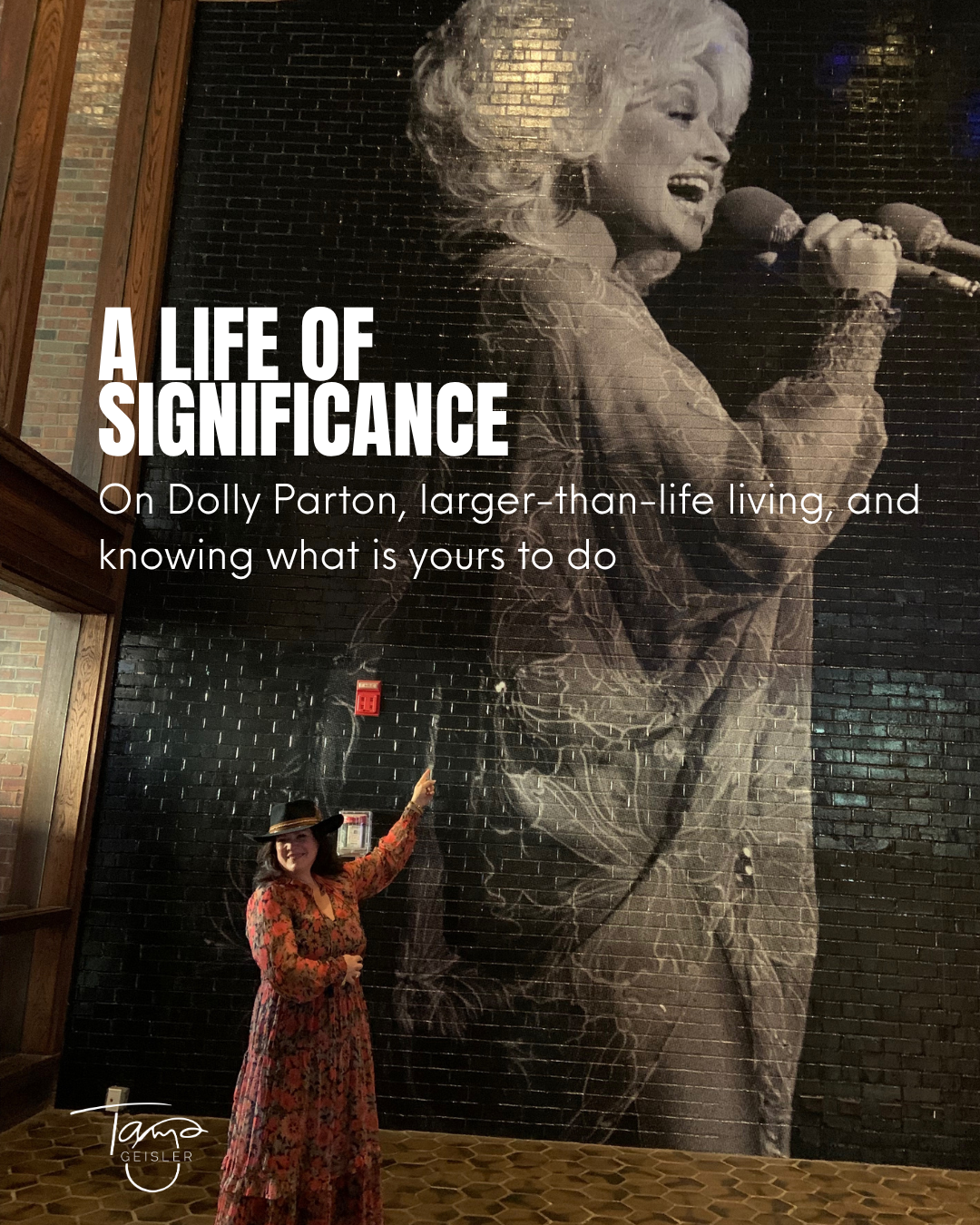
Last Sunday, Greg and I were driving home after a very extroverted visit with friends. We were quiet, as we often are after that much peopling, and I found myself thinking about four words:
“A life of significance.”
I think that’s what we all want, right?
Not necessarily fame. Or scale. Or even legacy, exactly.
But to have been here and have it matter that we were.
Then, on Tuesday, we lost Dolly Parton.
Talk about a life of significance.
And what is there to say about Dolly that hasn’t already been said this week?
And should be.
The talent. The songs. The rhinestones. The business acumen. The Dollywood of it all. The millions upon millions of books sent to children. The philanthropy. The bawdy and brilliant humour. The extraordinary generosity.
The fact that she somehow managed to become larger than life while remaining unmistakably, specifically herself.
Of everything I read this week, I’m mostly returning to Tressie McMillan Cottom’s piece in The New York Times about the stories Dolly told about herself.
We know them.
The one-room cabin. The 11 siblings. The coat of many colours. The bus to Nashville the day after graduating high school. The husband who stayed largely out of sight. The NO to Elvis.
Dolly told and retold those stories for decades.
One of Cottom’s many evocative points, as I read it, was that Dolly understood something about becoming a public figure: if you are going to become a story, you’d better have a hand in writing it.
Larger than life was, at least in part, by design.
And sometimes you have to write your own stories, else badly behaved people will try to do it for you.
Lord knows, they tried with Dolly.
A few years ago, I was listening to a group of men talk about her appearance at the NFL halftime show.
They had very strong opinions about what a 77-year-old woman should look like. How she should dress. How she should age. How much of herself she was still permitted to show.
I said something in her defence about Dolly Parton having earned the right to dress however she damned well pleased—and having also earned our respect.
Blank stares.
And then I walked away, knowing those fools weren’t going to get it.
I remember thinking about how many fools Dolly Parton must have had to contend with in her lifetime. How many people underestimated her intelligence because of the hair or the breasts or the accent or the jokes. How many wanted to reduce her.
But by her own hand, she refused to be reduced.
Bigger hair. Bigger voice. Bigger boobs.
Seriously: a Goddess.
Greg told me this week that when she showed up to film 9 to 5—her first movie—she had memorized not only her own lines, but everyone else’s.
My first thought was: Of course she did.
Because SO many of the stories coming out about her this week were about how hard she worked. Her tenacity and resilience and fortitude.
My second thought was more of a feeling than a thught and it was that of pure ache.
How hard she worked. And how hard she must have felt she had to work.
And I need to be careful here, because that second sentence is mine, not hers.
Maybe she didn’t feel she had to. Maybe she simply chose to.
Every account of her life canonizes her work ethic. She was prepared. Prolific. Shrewd. Tireless. She wrote thousands of songs. Built businesses. Made movies. Toured. Gave enormous amounts of money away. Kept going.
And, if I’m honest, part of me thinks:
God, that sounds exhausting.
But I also spend my days working with extraordinarily capable women. I know something about what it costs to be underestimated and then become very, very good at making sure nobody gets to make that mistake twice.
So I know what I might be projecting onto Dolly.
Maybe the preparation, the prolificness, the sheer volume of work was simply hers. Maybe she loved it.
I don’t get to know.
What I do know is that I’m much less interested in the fools Dolly encountered than I am in what she did with the enormous life she built.
Because the remarkable thing about Dolly wasn’t who she walked away from.
It was who she kept walking toward.
For decades.
She gave books to children. Hundreds of millions of them. She invested in the place she came from. When wildfires tore through East Tennessee, she helped families who had lost their homes. When COVID came, she put a million dollars toward research that helped fund the Moderna vaccine.
She gave and gave and gave. And she showed up.
Which might explain something else about Dolly: how fiercely people loved her.
So when the moment came to say something true, she said it.
When the Dixie Stampede was called out for its name, she changed it.
When she was asked about Black Lives Matter, she did not hide behind some carefully focus-grouped neutrality. “Of course Black lives matter,” she said. “Do we think our little white asses are the only ones that matter?”
And I suspect she changed some minds.
Because she had deeply embedded roots of love and kindness. She had spent years loving people in ways they could recognize.
I think that's part of what explains her extraordinary popularity.
She wasn't beloved because she stood for nothing. She could stand for something because people already knew who she was.
Not being known by a lot of people.
Knowing what is yours to do. And doing it, over and over, until people know what you stand for.
When I was in the car last Sunday, turning over what it means to live a life of significance, I didn't know we'd lose someone two days later who had done exactly that.
Rest well, Dolly.
You wrote the songs and the stories, built the businesses, gave away the books, wore the rhinestones, and showed us what larger than life actually looked like.
We will indeed always love you.
And thank you for always loving us all…even when I'm not sure we deserved it.