

Articles
Twenty-Two

Dearest Lauren -
This has been a pretty intense period in your ever-unfolding life — finishing university, settling into your new job in provincial politics, adjusting to who's in your life and who isn't.
AND this is the first morning that we’ve not been in the same city on the morning of your birthday.
I am sure I had made up endless stories about how I would me feeling on the occasion of this particular first. But happily, it’s surprisingly calming to know that you are exactly where you need to be, where your heart is holding court.
Who knew?
(Every other parent who has navigated this particular transition, I’m guessing.)
But I thought to write this year’s letter not with a first, but with a last.
A last that happened just two weeks ago.
(Now, do I know for a fact that it’s a last? No. Nothing is certain…and let that be life lesson #6831 for you. But let’s just say the odds are good that it will be the last.)
The Last Sick Day from School
It was the day after I had just sent a particularly tough rewrite to my literary agent. This one took a lot out of me and frankly, this whole process has been far more excorating than I had imagined. So I was a little spent and distracted.
But you had been in Ottawa over the weekend. And your body was exhausted from the travel, late nights and working as hard as you have been with finishing out your final papers of your undergrad uni career AND going over-and-above at your part-time comms job given the wild political antics in our province
Your sweet body has always responded to over-extension by getting pretty serious about the fever and chills to let you know that you have no choice but to slow it way down and rest
Something about the convergence of you feeling sick and me feeling like I needed some time away from working, I gave myself over to taking a little extra care for you. And somewhere in between tucking you in and making sure the heating pad was working and steeping another cup of hot water infused with honey, ginger and lemon, I realized that this was it
Of all the days I've imagined: first day of kindergarten, then the last days of grade school, middle school, high school, the first day of university, dorm move in (and the silent drive home), and all the days I dare not dream about, I did not see this one coming.
Last sick day home from school.
A relatively innocuous moment I just never thought to anticipate.
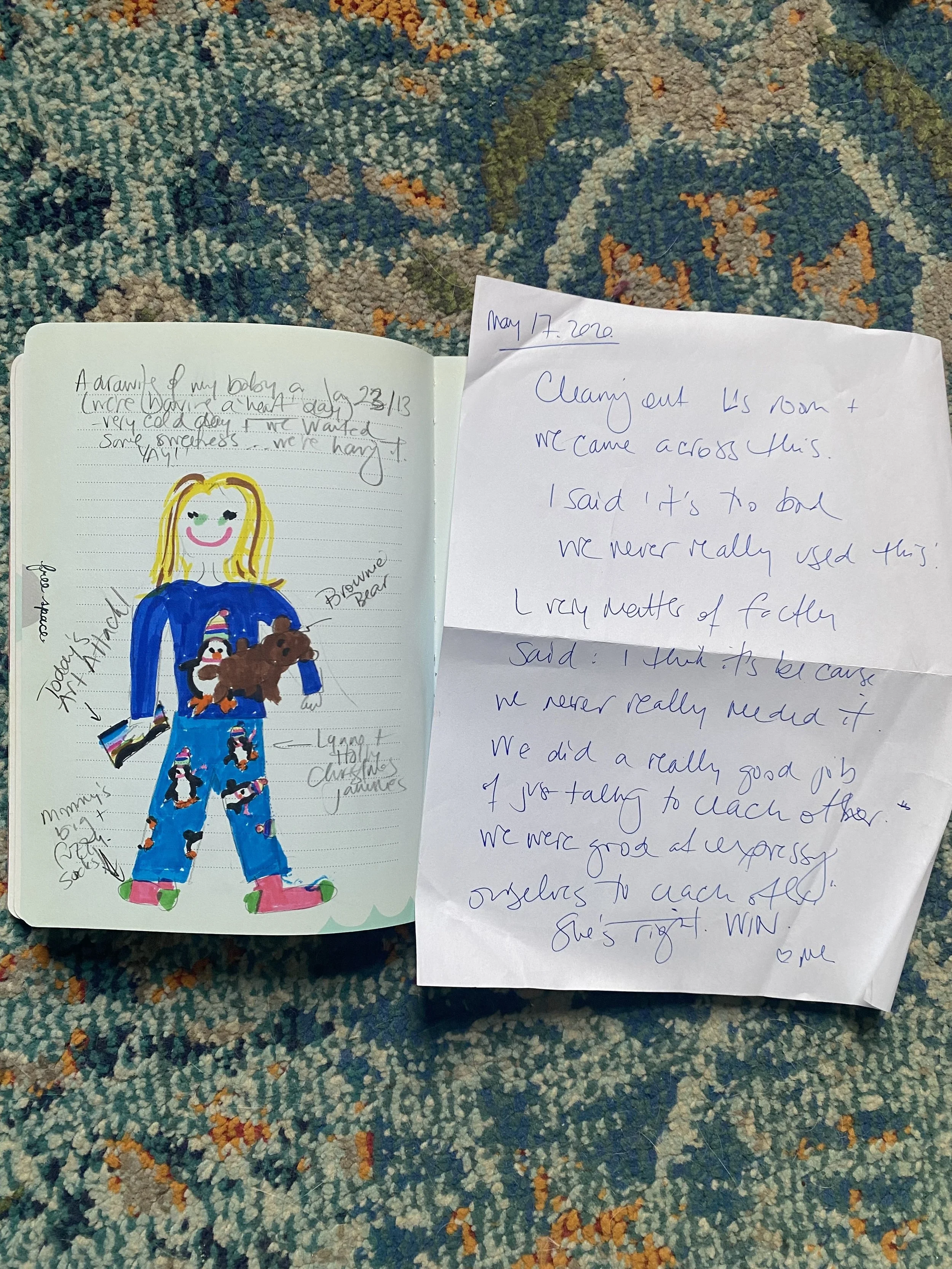
As you snoozed away, I decided to pull out the “just between us” journal that we used for a very brief moment when you were around eight.
It opened to a page with a drawing I did of you, from a day in middle school. Perhaps I drew it knowing there would be a moment a decade or two or three out that I would want to remember what these fleeting and numbered days were about. It reads: “A drawing of my baby on Jan 23/13. We're having a "heart" day. Very cold and we wanted some sweetness...we're having it.”
A note fell out of it as I picked it up to look closer.
That note reads: “May 17, 2020 Cleaning out L's room and we came across this [journal]. I said “it's too bad we never really used this" as there were very few entries. L, very matter of factly said: I think it's because we never really needed it. We did really good job of just talking to each other. We were good at expressing ourselves to each other.” She's right. WIN.”
WIN, indeed.
I share this because it underscores two things that matter fiercely to me.
You cannot know how deeply I hope that our connection continues to span time and space as a RESULT of our clear and truthful communication. I suspect we’re pretty well set up for that. I am infinitely grateful.
One of the things I'm proudest of in my role as your mother is helping you to listen and care for your mental and physical health. Maybe not in the eat fibre, work out and take vitamins way, but certainly in the listen to your body and take its cues seriously. You know how to attend to yourself. You know how to rest (mostly) without guilt. May you take that with you always.
So yeah, I had a moment when I realized that the tuck-ins, like everything else, were finite.
And so, just like everything else, a reminder to cherish all I can with as much presence as I can hold.
Listening to the political podcasts that bore me to tears but have you captivated as you get ready in the morning from the other room.
The ‘fit checks’ that demonstrate your evolving style.
Watching you bound out the door with purpose AND lightness only to be stopped by a neighbourhood cat or dog who needs a skritch. You ALWAYS stop and deliver.
Witnessing the way everyone comes alive in your presence…babies, people you hold doors open for at the store, nail technicians, people you work with who happen to be leading governments that we bump into on flights, baristas...everyone.
You’re graduating in just a couple of weeks. You’ve grown and learned and navigated stress and competing priorities and bureacracies and scheduling and learning to ask for help and grace when needed and to dig in where required. And in return, you’ve found yourself rich in relationships, creative pursuits like your college newspaper and sitting on the dean’s list every year. Surpassing any academic feat your father or I even considered for ourselves.
I’m a touch breathless as I write this. Just as I was when I wrote you when you turned eight, nine, ten, eleven, twelve, thirteen, fourteen, fifteen, sixteen, seventeen, eighteen, nineteen, twenty and twenty-one.
Truthfully, I have no idea where you’ll be this time next year. Traveling? Living at home? In your own place? In another city closer to the federal action?
We are at that precipice point of the great and very exciting unknowns.
As much as I appreciate that you listen to your father and me, it’s even more important that you listen to yourself. And you do and you are…because you know how to take care of yourself in the ways that matter the most.
We couldn’t possibly be prouder of you than we are right now.
I just hope you feel proud of yourself too.
You are so ready.
But first, we are off to pick you up from the airport, and we’ll eat cupcakes and sip prosecco and listen to the stories of your adventures, and bask in the light that you are.
Gratefully. Ever gratefully.
x/Mama
The Trailblazer Phenomenon™: Why the Language of 'Complex' No Longer Fits
"Mi nombre es Benito Antonio Martínez Ocasio, y si hoy estoy aquí en el Super Bowl 60 es porque nunca, nunca dejé de creer en mí. Tú también deberías de creer en ti. Vales más de lo que piensas, créeme."
"My name is Benito Antonio Martínez Ocasio, and if I'm here today at Super Bowl 60, it's because I never, ever stopped believing in myself. You should also believe in yourself. You're worth more than you think, trust me."
When Bad Bunny spoke those words on one of the world's largest stages last week, he introduced himself by his full name. He carried language, culture, gender expression, and national pride into a space that has rarely centered voices like his. He was unapologetic in his fabulosity and did not contort himself into something many said would be easier to digest.
The halftime show was a masterclass in resistance, joy, and meaning. I learned. I was moved. I felt hope.
And then Monday morning came.
The commentary arrived right on schedule. He went too far. He didn't go far enough. And I'm not just talking about the predictable camps demanding he "speak English"—I'm talking about fractures that appeared even within communities that had previously supported him.
An ever-present reminder for all Trailblazers: you will be too much for some people and not enough for others, with a world that sits in between.
Some may say it’s a hard world to navigate, but for me, I see it as a very wide sweet spot. A chasm of possibility, really.
For years, I've worked with leaders experiencing Imposter Complex at inflection points in their leadership—and then evolved that language to the Trailblazer's Complex. That reframing mattered. It shifted the focus from "what's wrong with you" to "what are you courageously building."
(Side bar for those tracking the evolution of language: I’ve written extensively about why “Imposter Syndrome” misses the mark in favour of “Imposter Complex.” “Syndrome” pathologizes the experience. But even “complex” still implies dysfunction—something to fix. So I’m upleveling it.)
And I’ve known, and taught, all along that it was never any of those things. That the self-doubt that arose at the precipice of expansion wasn’t proof that you shouldn’t be doing it, but rather a predictable experience that arises when you lead in places without precedent.
Enter: The Trailblazer Phenomenon™.
The Distinction That Changes Everything
All people who experience Imposter Complex are Trailblazers. But not all Trailblazers experience Imposter Complex.
Some leaders—like Martha Stewart, who has publicly dismissed experiencing Imposter Syndrome (and I had many thoughts about it that I wrote here)—move through scrutiny and innovation seemingly without internalizing doubt. Her response makes sense here, because whether doubt surfaces for her or not, the terrain remains.
The Trailblazer Phenomenon™ describes that terrain—the full landscape of what happens when you're First, Only, or Different (F.O.D.). When your identity, approach, or vision doesn't fit established norms. When you're building without a template.
Which means the focus shifts from "what's wrong" to include the conditions shaping the experience.
Misunderstood Brilliance
Your ideas are filtered through bias, projection, and unfamiliarity. You can be admired and misread in the same moment, celebrated for your outcomes while quietly resisted for your process.
We’ve seen time and again that brilliance ahead of its time looks disruptive before it looks visionary.
And when that brilliance comes in a body or identity that's been historically underestimated, the distortion intensifies.
The Visibility Tax
For many Trailblazers, you're not just leading—you're representing. Your success gets treated as exceptional, an anomaly rather than evidence of competence. Which unfortunatly means that your mistakes carry disproportionate weight. The margin for error narrows as influence expands.
Ever heard: “heavy is the head that carries the crown?” THAT.
Take Gu Ailing at the Olympics.
At just 22, she became the most decorated female freestyle skier in history. And still, at a press conference, a reporter asked whether she considered her two silver medals “two silvers gained or two golds lost.”
Her response was immediate and grounded:
“I’m the most decorated female freeskier in history. I think that’s an answer in and of itself… I’m showcasing my best skiing. I’m doing things that quite literally have never been done before. And so I think that is more than good enough.”
More than good enough.
Her record stands. Her pride is earned. And yet the question lingers.
With every rung of success, the spotlight intensifies. The achievement expands. So do the expectations.
That is the Visibility Tax.
The Blueprint Void
There's no template for what you're building—at least not by someone like you. You're designing the architecture while inhabiting it, writing the playbook as you work out the steps, and to round out the metaphors: building the airplane in the sky.
All the while being measured against it, expanding categories that didn't previously include you.
Creation under those conditions generates both exhilaration and isolation.
And to work in this space demands grit and stamina. Good thing you've got both in spades.
Environmental Obstacles
The very landscape the Trailblazer navigates isn’t just unmapped…it’s literally resistance.
Some of what you encounter is structural friction — systems calibrated to reward what already looks familiar. Funding models that privilege pattern recognition. Leadership archetypes shaped long before you arrived. Informal rooms where decisions are made and you are the First, the Only, or the Different presence at the table.
And sometimes it is less institutional and more intimate. You may be the first in your family to start a business. The first to step into the arts without a safety net. The first to choose a path that doesn’t resemble anything you inherited. There is no template on the kitchen table. No one to show you the hidden levers. You are building while learning how building works.
You did not design those conditions. And they still require energy to move through.
Then there are moments of deliberate resistance. Gatekeeping. Dismissal. Exclusion. Individuals or institutions invested in preserving the status quo because your presence stretches it.
Not every barrier is malicious. Also true: not every barrier is accidental.
But what matters is that the terrain is real.
When you are blazing a trail, you are not simply building something new. You are navigating conditions that were not originally designed with you in mind. That reality demands strategy, stamina, and discernment.
Understanding the terrain does not remove it, but it does restore perspective.
And perspective protects your agency.
Imposter Complex
Since 2012, my work has centred on understanding and helping leaders navigate Imposter Complex — across articles, keynotes, workshops, and coaching rooms. I have studied its behavioural traits, its protective strategies, and the way it activates precisely at the edge of expansion.
That body of work stands.
What has evolved is the container.
Imposter Complex rarely operates in isolation. It emerges inside specific conditions: heightened scrutiny, limited precedent, the weight of representation, and the structural terrain just described.
If we call this “just” Imposter Complex, the burden stays entirely inside the individual. You are left to mindset your way through conditions that are not imaginary.
But when we name the Trailblazer Phenomenon™, we widen the frame.
Within that wider frame, the internal activation makes sense. It is not proof that you are unqualified. It often signals proximity to something that matters deeply.
And just how deeply you want it.
Some Trailblazers feel that activation intensely. Others move forward with remarkable steadiness.
Both are navigating the same terrain.
Which brings us to the question that always follows:
Why Blaze Trails At All?
Because we are called to do so.
Because the world is beautiful — but in desperate need of improvement.
Because everything we say we want — equity, creativity, innovation, representation — lives on the other side of resistance.
Because progress has never been powered by compliance.
Because on the other side of trailblazing lives the kind of joy and brilliance we witnessed on that Super Bowl stage.
Those of us who felt that shift will never un-feel it. We will not forget the pride, the audacity, the full-bodied presence of someone refusing to shrink.
And as we’ve seen with Bad Bunny and Ailing Gu, there will always be “too much” and “not enough.”
Even excellence is critiqued. Even history-making performance is second-guessed.
Scrutiny is not the exception. It is part of visibility.
So if the scrutiny is coming either way, you might as well build the thing that needs to exist.
I believe, with everything I know and am, that fortune bends in favour of those who believe in a future that doesn’t exist yet — and then work to make it happen.
You are not navigating this terrain because you enjoy difficulty. You are here because you can imagine something that is not yet here. For you. For us. For what comes next.
You are reclaiming language that once misnamed you.
The world does not need more people colouring within inherited lines.
It needs your voice.
Your lineage.
Your story.
Your lived experience.
Your magnetic contradictions.
Your fire.
Your care.
Your presence.
The resistance is just part of the gig.
And the gig is so much more than worth it.
But calling is not enough. Trailblazers who become icons develop footing.
From Trailblazer to Icon: The ICONIC Framework™
If this is the terrain, coherence becomes non-negotiable.
Over more than a decade of studying and teaching on Imposter Complex, I’ve observed a clear pattern. Some Trailblazers move through scrutiny, friction, visibility, and expansion without fragmenting. They still feel the stretch. They still face resistance. They still get misread. What distinguishes them is not ease. It’s integrity of self.
There is a structure beneath that steadiness.
I call it the ICONIC Framework™.
I — Identity
Every icon makes the internal move long before the culture catches up.
The irony is that Trailblazers often judge the very patterns that signal that move is already underway. Perfectionism. Comparison. Procrastination. People-pleasing. Diminishment. What gets labelled as weakness frequently carries a golden shadow: devotion to excellence, humility paired with vision, discernment mistaken for procrastination.
Your leadership edge is rarely something new to acquire. More often, it is something to reinterpret and claim.
Bad Bunny did not step onto that stage wondering whether he belonged there. He stepped onto it in authorship.
Mi nombre es Benito Antonio Martínez Ocasio.
Identity first.
You must see yourself as the leader you are before the room confirms it. Visibility without identity destabilizes. Visibility anchored in identity steadies and sharpens. This is the root. Without it, everything wobbles.
C — Confront
The Imposter Complex has always aimed for three outcomes: paralysis, self-doubt, and isolation. It operates through critics — external, inherited, and internalized.
Confronting is not about fighting every voice. It is about discerning what is actually present. Is the objection strategic? Structural? Protective? Fear-based?
When you name the critic accurately, you respond with precision instead of reflex.
O — Optimize
High-achieving leaders routinely forget their proof, largely because the ego prefers striving over arriving.
Optimization is the disciplined remembering of what you have built, delivered, healed, survived, and created despite resistance. It is the gathering of internal evidence before seeking external validation.
When you optimize, you build self-efficacy and you remember your authority…with no need to manufacture it.
N — Network
No one was built to navigate this terrain alone. Icons assemble ecosystems — teachers who shaped them, peers who sharpen them, those rising behind them who they lift as they climb.
Perspective stabilizes inside support.
I — Implement
Also known as “do the work”...also know as “take action”. Because confidence follows action, and not the other way around. Trailblazers move before certainty settles. They iterate, refine, and adjust in motion.
Like I’ve always said: simple, but not easy.
C — Celebrate
And possibly the most resisted step trailblazers? Celebration. But I insist upon it because integration signals completion. Celebration closes a cycle of exertion (and expansion) before the next begins. It’s a capacity builder unlike any other….and icons know it.
Without integration, momentum becomes depletion. With it, growth becomes sustainable.
Why This Evolution Matters
The language of “complex” kept us asking what's wrong with you. The language of “phenomenon” asks what's happening around you. It’s a shift that changes everything.
It situates internal experience within external conditions. It accounts for identity, visibility, innovation, and systemic and structural contexts simultaneously. It holds personal responsibility while acknowledging environmental reality.
Leaders who recognize themselves here often feel something both subtle AND seismic: relief. The relief of context.
If you've felt capable and scrutinized, visionary and questioned, energized and destabilized—your experience makes sense inside this terrain. The ground beneath you may be uneven, but you're still moving forward.
And forward motion, anchored in identity, is how Trailblazers become icons.
I’m here for that.
Twenty-One

Dear Lauren,
I think I’ll forego the annual reference to how fast time is passing us by. (Lord knows I’ve covered that theme well enough in my previous letters for when you turned eight, nine, ten, eleven, twelve, thirteen, fourteen, fifteen, sixteen, seventeen, eighteen, nineteen and twenty.)
Like every year for the last 14 years, I’ve sat at my computer searching for the words that might come close to expressing the depth of my love for you—and the awe I feel in witnessing who you’re becoming.
Time for a famous Geisler/Sarney woman sidebar: Do you know that every time I cut your father’s hair—something I’ve been doing every three weeks since the start of COVID—he always says the same thing after he surveys the results in the mirror? “Well, I’m going to go out on a limb here and say… this is your finest work yet.”
Of course, he’s now said it about 81 times (give or take), so I cut him off after the “well,” but honestly, if I didn’t hear it, I’d feel sad.
I feel the same way writing this letter to you as I have for the past 14 years.
Worried that THIS time, I will have failed to encapulsate or name my absolute and profound love for you. Worried that THIS time you won’t receive a reflection of the you we are fortunate enough to see.
Because being seen, as you know, matters. And I pride myself on reflecting well.
Except when I don’t.
This year, there’s a note of melancholy in this letter. You might feel it around the edges.
To say it’s been a hard year would be reductive.
It’s been brutal.
And the world? It’s rougher than I ever hoped it would be when you opened your eyes on your 21st birthday. News cycles filled with leaders—and those who empower them—disregarding humanity and the planet. Injustices I wish I could shield you from. But I can’t. And I wouldn’t. Because that’s not what you’re here for. And it’s not how we do.
Last night, as we marvelled over the incredible plant-based Japanese steak at Planta (seriously—how do they do that?), and again over molten lava cake in our little corner of the world, you opened up about what’s weighing on your ever-expanding heart.
More than once, I caught my breath.
I pride myself on being attuned to all that you are holding. But this year, it’s been harder to track it all. Mostly because the hits have been coming from every corner.
And when I say I’m proud of you, I mean I am PROUD.
I fail (often) and I get a lot right (often). But your grace for my humanness (and hers, and his and theirs) is what makes you legendary.
And the way you allow yourself to BE with the hard and the disappointment and the fears as WELL as the joys, whatever they may be, well, damn. That’s some quality maturity I didn’t have access to until I was well into my 30’s.
I believe that at your best, you remember your literary crush Walt Whitman’s "I am large, I contain multitudes."
I think you have that on lock as a touchstone to come back to.
So today, I want to offer you a different invitation from Walt Whitman. One that feels right for now:
“I celebrate myself, and sing myself,
And what I assume you shall assume,
For every atom belonging to me as good belongs to you.”
— Song of Myself
Let’s break it down.
“I celebrate myself.”
Not someday. Not when you’re the perfect version of you feel you are supposed to be. The one who wakes without an alarm and never gets it wrong and always reflects the best and loves the gym and gets the perfect job and loves every part of herself and always says the right thing and always always always chooses to fight the good fight and has the shiniest hair (this one may sound all too familiar).
Not then.
Now.
An invitation to stand tall in your identity, your beauty, your becoming. As you are. Because the fact that you exist is more than reason enough for celebration.
“... and sing myself”
And today? On your 21st birthday? My God. Sing as loud as your lungs will allow.
You won’t be singing alone, mind you. Your voice will be joined by a chorus of friends, family, neighbours, acquaintances and chosen family overjoyed to celebrate the stunning revelation of a human that you are.
(And yeah, you KNOW I’m woo enough to remind you that your and theirs and ours are STILL not the only voices singing. You’ll be hearing in stereo as some beloveds sing from the other side too.)
But my deep desire is that you learn to sing yourself. For when we do get it wrong and drop the ball. Like we have, and like we will.
Sing yourself for your wit and your wonder. For your honesty and your charm. For your non sequiturs and your laser-sharp insight. For your beauty and your righteous rage.
There is oh so much to sing about. Maybe that’s why I found myself breathless last night.
And then notice how Whitman folds you into the universe itself. Every atom that belongs to him, belongs to you too.
Which means—
You are part of everything.
EVERYTHING.
You belong.
You matter.
And your voice—your being—is essential.
Worth celebrating, worth singing.
Remember that.
I love you with all I have, and then some, and then some more.
/Mama
The Masks Always Slip (Good Thing You Don’t Need to Wear One.)

Over the weekend, while recovering from the Norovirus (10/10 do not recommend), I found myself watching two wildly different Netflix productions that somehow spoke the same uncomfortable truth.
One was Apple Cider Vinegar—like its namesake, a bracing look at the wellness industry that may be hard to swallow for some. Compelling enough that I watched the whole series in one sitting (okay, in one laying). The other was Kinda Pregnant with Amy Schumer—sporting a Rotten Tomatoes rating of 19% that some might say is generous… and yet? It was entirely and ridiculously enjoyable, and exactly what my beleaguered brain and body could handle.
The common thread? Fraudulence.
Both played with the idea of someone pretending—convincingly, at first—until, inevitably, the mask slipped. And watching that unravel is deeply uncomfortable. Because we know what’s coming.
Let’s be clear: We are (I trust) not out here faking brain cancer in some Munchausen-fueled scam or donning stolen rubber baby bumps to fake pregnancy.
And yet… that moment. That fear of exposure. That bone-deep "what if they find out?" feeling?
That’s viscerally familiar.
Fraud Watching: Our Favourite Pastime
The downfall of a fraudster has become appointment viewing.
From The Dropout (Elizabeth Holmes’ Theranos scandal) to Inventing Anna (Anna Delvey’s con artistry in designer clothes and a truly baffling accent), to Fyre: The Greatest Party That Never Happened (Billy McFarland’s Instagram-fueled festival scam that left influencers stranded with cheese sandwiches)—we can’t look away as these so-called visionaries get exposed for the frauds they always were.
Our own schadenfreude kicks in as we watch them delude, deceive, and ultimately destroy themselves.
Because we’re not them.
And yet?
We still fear being “found out,” in spite of what the evidence shows.
The Imposter Complex Has You Bracing for a Reckoning That’s Never Coming
You’re not faking. You’re not playing pretend. You’re not conning anyone.
But the Imposter Complex would have you believe otherwise. It’s waiting for the moment you slip up, certain that someone—anyone—will finally expose you for the fraud you secretly suspect you are.
And yet.
Check the receipts.
You earned the gig.
You asked for the work.
You put in the reps.
You ran your paces.
You showed up. Again. And again.
That’s not luck. That’s not deception. That’s yours.
Alain de Botton on Why We Fear Being Found Out
In his classic book, Status Anxiety, Alain de Botton argues that much of our fear isn’t about failure itself—it’s about how others will perceive that failure. The shame, the judgment, the imagined humiliation.
Which is why we hesitate.
Not because we aren’t capable. But because we assume there’s an invisible jury, always watching, always waiting to pass judgment.
But what if that audience isn’t as invested in our downfall as we think?
Like I said: unless you faked cancer, jammed a roasted turkey up your dress, or spent years speaking in a faux-European accent, your fear of being exposed is wildly disproportionate to reality.
From Imposter Complex to Trailblazer’s Complex
The fear of exposure might feel real, but what if it’s just… misplaced?
What if this isn’t proof that you don’t belong, but rather proof that you’re at the edge of something bigger?
In Think Again, Adam Grant highlights that true experts tend to doubt themselves, while the least competent are often the most confident. (See also: the Dunning-Kruger effect.)
That discomfort you feel? It’s not proof you don’t belong—it’s proof you care. Proof that this matters to you.
And that feeling pulling at you—the weight of stepping into something bigger? That’s not fraudulence.
That’s what I call the Trailblazer’s Complex—the discomfort of leading beyond the status quo.
It’s proof that you’re in the arena, doing the work, pushing the edges of what’s possible.
The frauds aren’t feeling this. They’re marching forward in full delusion, wearing crowns they never earned.
You? You put in the work. You know this matters. You feel the weight of it all because you actually give a damn.
That’s what trailblazing feels like.
Meanwhile, in the Real Hall of Mirrors…
This whole moment in history is peak Emperor’s New Clothes—full of leaders (and I use that term loosely) swaggering around, insisting their robes are majestic when it’s clear to anyone with eyes that they are wearing nothing but bravado.
And it works. Not because they’re competent, but because they’re loud.
Meanwhile, you—the one actually doing the work, holding the line, delivering the results—wonder if you belong.
Enough.
You’re Not Playing King. You Are an Authority.
You don’t need to fake it. You don’t need to act like you belong.
You already belong.
So now? Make it yours. Own it. Claim the space you have earned.
Because if you don’t, someone else will.
And let’s be honest: do we really need more emperors strutting around in imaginary robes while the real leaders hold themselves back?
Or is it time for the ones actually doing the work to take up the space they’ve earned?
Martha Stewart Laughs at Imposter Syndrome—What’s the Joke?

When Martha Stewart laughed off a question about experiencing imposter syndrome, it sparked a wave of reactions. I’ve had dozens of people (and counting) send me the clip—some inspired, some annoyed, some just… puzzled.
For many folks, her laugh was aspirational—a woman so self-assured, she doesn’t waste time second-guessing herself. Fantastic! For others, it was a clear sign of privilege: the kind that allows someone to move through the world without ever questioning their place, finding the very idea of doubt absurd.
FWIW: I loved the Martha Stewart documentary. I appreciate the way she is exactly who she says she is. Authenticity is compelling, and there’s something undeniably magnetic about her confidence. (And I will never use a small knife to cut an orange, if I ever did.)
But laughing at the Imposter Syndrome? Feels complicated.
Because for most trailblazers, the Imposter Complex (IC) is real. And yet, it’s deeply misunderstood, misused, and the way we talk about it can be weaponized in all manners of ways that leave people—especially women and systemically excluded leaders—out of action and questioning their worth…which is what the IC is already trying to do.
The Difference Between Underestimated and Overestimated
I’ve said it before and I’ll say it again and again: being in spaces where your competence is underestimated is not the same as feeling like your competence has been overestimated.
When you stop short of raising your hand and challenging the status quo because the institutional groundcover to support you isn’t there, that’s not a “play bigger, stop diminishing” problem or an IC problem. That’s a “this-system-isn’t-designed-for-me” problem.
And feeling like you don’t belong is worlds apart from being told you don’t belong.
But here’s the thing: the IC doesn’t ask about context. It doesn’t care whether your doubts come from systemic barriers or internal struggles. It just whispers, “You don’t belong here,” leaving you questioning your worth. And that’s why it’s so damaging—it isolates, invalidates, and keeps trailblazers out of action, even when their competence is beyond question.
And this is why we need tools.
The Dunning-Kruger Effect and Trailblazers: A Tale of Two Extremes
The clip of Martha captured momentum just as cabinet appointments in the US fill with individuals who are largely glaringly unqualified, making it impossible to ignore the stark contrast between the Dunning-Kruger effect and the Imposter Complex.
On one side, we see people emboldened by systems designed to cushion their falls, confidently overestimating their competence. On the other, trailblazers—overprepared, undervalued, and constantly second-guessing their place in the room—must navigate spaces that weren’t built for them.
For women, systemically excluded folks, and anyone breaking barriers, this isn’t a theoretical divide—it’s lived. And it’s exhausting.
The PMS Parallel: Diminished and Weaponized
When folks are told, “Oh, you just have imposter syndrome,” but the reality is that they’re being underestimated, it’s beyond infuriating. It’s reductive. It’s gaslighting. It’s like telling a woman who has the audacity to not smile because she’s over it, “You must have PMS.” It’s insulting. It’s a huge NOPE.
We know better. But knowing better doesn’t erase the existence of PMS—or the Imposter Complex. Both are real experiences. They might not be an actual issue for the accused in that moment, but denying that they exist at all isn’t the answer either.
The IC already isolates and invalidates. It keeps trailblazers out of action and doubting their worth. Dismissing its existence doesn’t solve the problem—it amplifies it.
I Feel Fear. I Should Feel Fear.
Fear is an instrument of evolution—and so too is the Imposter Complex. When I hear someone say they laugh in the face of fear, it doesn’t inspire me. It just makes me feel like I’m getting one more thing wrong.
Every time I take the stage, I feel the fear that THIS is the time I fall flat on my face. THIS is the time they find out I’m not supposed to be here.
And so, I remember the words of Viola Davis in an interview after she won an Oscar: "I still feel like when I walk on the set, I'm starting from scratch, until I realize, 'OK, I do know what I'm doing. I'm human.'" Her words embolden me, reminding me that even icons feel the weight of doubt—but they press on, grounded in their humanity and their craft.
And then I step into the spotlight, and I give it all I have because the audience deserves nothing less.
Feeling fear isn’t failure. It’s intended to keep you safe. The IC is no different. It shows up when you’re about to do bold, audacious work—work that challenges you to grow. And it’s not a fan of that. Learning to work with it, rather than against it, is the work I teach.
Reframing the IC as the Trailblazers’ Complex
That’s also why I call it the Trailblazers’ Complex. It’s not a symptom of inadequacy—it’s a sign of growth. It shows up when you’re leading in spaces that weren’t necessarily designed for you, challenging the status quo, and paving the way for others to follow.
Trailblazers are the ones willing to go first. They’re the ones breaking down walls, questioning norms, and daring to create something entirely new. That kind of boldness doesn’t come without resistance—both from within and from the world around you.
The Way Forward
Martha Stewart laughed. Maybe she’s never felt the Imposter Complex. Maybe she’s always had the confidence to walk into every room and own it. That’s her story. I love that for her.
But for most of us—especially those carving new paths—the IC is real. And if we allow it to be, it will simply be a signal that we’re stepping into the unknown, blazing trails where few have dared to go.
Here’s what to do when it shows up:
Pause. Recognize that doubt is part of the process.
Take the bold steps forward anyway.
Name it for what it is: a signal of expansion.
This experience doesn’t mean you’re not ready—it means you’re on the edge of something extraordinary. Something like everything.
So: name it. Deal with it. And then keep going, icons.
This is your moment.
And yes, it’s a good thing.
From Imposter to Trailblazer. (And why that matters)

(If you’ve been reading my work for a while and already know how I see the Imposter Complex, feel free to head to start reading this at “Introducing, the Trailblazer's Complex.)
I recently had the incredible good fortune to speak with a group of powerful mavens in the Venture Capital industry. These women are devoted to finding, backing and building category-busting companies that reflect changing demographics, including aging, the rising economic power of women, the shift towards the global majority, and innovative healthcare solutions. Disruptors, through and through.
And? They operate in an industry still overwhelmingly dominated by men.
The stats are pretty grim:
Only 12% of decision makers at VC firms are women.
Only 2.4% are founding partners at VC firms.
Women-led startups received just 2.3% of VC funding in 2020, and of 120 new unicorns (a grade A big deal) in that year, only 10 were female-led. (Source: Crunchbase)
Women hold just 10% of executive-level positions at tech companies globally.
The 2023 Midas List of 100 founders featured only 11 women, the same as in 2022 (with ONE Black founder).
Like I said…grim.
So it stands to reason, the Imposter Complex (or Imposter Syndrome as most people call it) can be UP for some of these women. You know, that sneaky, undermining voice that whispers, "Who do you think you are?" That nagging doubt that convinces you you're not enough, despite all evidence to the contrary. And yet, there they all were, rising to the top.
In short, it was a group of women who have both experienced their fair share of Imposter Complex and are also paradoxically somewhat “over it.”
Because for many women, the “diagnosis” of the Imposter Complex is simply yet another misogynistic scheme designed to slow down women’s progress, as author, founder, and activist Reshma Saujani argues in her ubiquitous address to Smith College about “bicycle face”.
I get it. And I also get why it’s up.
As I’ve said before, the global self-development industry is worth $44 billion as of 2022.
That is a lot of money invested in making people feel like crap about themselves and like they need to be fixed (think diet industry but for confidence). I also want to acknowledge that I work and operate INSIDE of this industry.
AND I see how it’s deeply problematic.
I see the gaslighting, the reductiveness, the toxic positivity, and the manipulative and often predatory practices that can run rampant in the race for a slice of that $44 billion pie.
And I’m most assuredly not alone here.
Australian scholar and critic Rebecca Harkins-Cross writes: “Capitalism needs us all to feel like impostors, because feeling like an impostor ensures we’ll strive for endless progress: work harder, make more money, try to be better than our former selves and the people around us.”
All true.
And?
When us are in the thick of the Imposter Complex experience, it will take us out of action, have us doubt our capacity and keep us alone and isolated.
I’m less interested in TELLING folks what they are experiencing and far more interested in helping them when they find their experience is inhibiting their activation.
One of the other things that I have said for a very, very long time is that the experience of feeling like an imposter comes with some good news.
It means that you hold strong values of excellence, proficiency, and integrity.
It means that what you are doing MATTERS. For instance, I feel no IC in my yoga practice, my painting, my gardening, because those activities do not represent what matters most to me. Unlike my parenting, coaching, writing, and speaking…then it is UP.
It means that you are venturing into the unknown…at the precipice of your expansion.
And if I’m interested in living a life well-lived (which I am), the appearance of the IC has become a beacon signaling the arrival of something that I want…and something that I want to make happen.
But I have come to understand that not everyone holds the same perspective. And that language matters. So if the issue is in the imposter language, maybe it’s time to find language that more accurately reflects the experience.
Maybe it’s time to stop focusing on the fears and doubts and instead lean into the bravery, the innovation, and the path-breaking spirit that is the precursor to said doubt.
Maybe it’s time to claim the real real of what’s happening.
Maybe it’s time to call it something else.
Introducing, the Trailblazer's Complex.
Can you feel that energetic shift? Me too. Here's why.
First Out of the Gate
When you're a trailblazer, you're the first one out of the gate. You're charting new territory, exploring uncharted waters, and setting new standards. This can be both exhilarating and terrifying. But this is precisely what makes trailblazers ICONIC. They dare to go where no one has gone before.
Think of every last icon you admire. Oprah, Malala, AOC. They didn't wait for a road map; they created their own.
Ada Lovelace envisioned capabilities for computers that wouldn’t be realized for over a century, writing the first algorithm intended for a machine. She famously said: “That brain of mine is something more than merely mortal, as time will show.” And it DID.
Misunderstood Brilliance
As a trailblazer, not everyone will understand what you're doing. Your ideas might seem too radical, too ahead of their time. Almost by design, trailblazers out ahead of the pack often face skepticism and resistance.
To the old guard and upholders of the status quo, your new perspectives, new ideas, new energy, and new approaches applied to old problems can feel like a threat.
And not everyone’s gonna like it.
Every great innovator faced naysayers. Your job is to stay true to your vision, knowing that what seems obscure today may well become the new standard tomorrow.
And now is a good time to sidebar and acknowledge that this becomes exacerbated when trailblazers belong to groups that have been overlooked, underestimated, and systemically excluded. Women, people of colour, neurodivergent folks, members of the LGBTQIA+ community…you know what I’m talking about.
Alan Turing made significant contributions to the development of theoretical computer science and artificial intelligence. Despite his crucial work during World War II, the rampant homophobic discrimination and oppression he faced prevented him from receiving full recognition during his lifetime. (And worse.) “Sometimes it is the people no one can imagine anything of who do the things no one can imagine.”
Facing the Fear
Of course, the fear and self-doubt that we know as the Imposter Complex will still rear its head. It will tell you that you're not ready, that you lack the capacity, that you’re alone in your struggles. This fear is part of the Trailblazer’s deal. But make no mistake—it's not a stop sign; it's a signpost that you're moving in the right direction.
Amelia Earhart was clearly a trailblazer in aviation. In a time when female pilots were rare, her solo trans-Atlantic flight challenged gender norms and inspired countless women to pursue their dreams. “The most difficult thing is the decision to act, the rest is merely tenacity. The fears are paper tigers. You can do anything you decide to do.”
Following the ICONIC Path
For the most part, and with one notable exception, trailblazers don’t follow paths—they make them. And in doing so, they become unforgettable. You're not just participating in the world; you're shaping it. This is what it means to be ICONIC. Your courage to take the first step, despite the doubts and fears, is what sets you apart.
But time for that one notable exception. The ONE path for trailblazers to follow…if they want an easier journey, that is. It’s the ICONIC path…and it’s more of a framework than a path but it’s designed for trailblazers and it’s my life’s work.
Identity: You’re going to need to see yourself as the trailblazer you are. Full stop…or rather, full start.
Confront Critics: Address both external critics and your internal doubts. Understand their nature, and then engineer solutions to move past them. Rachel Carson faced significant opposition when she raised awareness about the dangers of pesticides through her book "Silent Spring," sparking the modern environmental movement and leading to policy changes. And yet, she persisted.
Optimize your Authority: Reflect on your achievements. Reflect on all that you have done and won and healed and survived and use this proof as scaffolding for the next and the next.
Network: Every trailblazer knows they were never intended to go it alone. Surrounding yourself with like-minded folks is the solve for the challenges inherent in this trailblazing life.
Implement Actions: You’ll need to take the next step and the next step and the next step if you’re going to blaze the trail. Action builds confidence…it’s not the other way around.
Celebrate: This may well be the trickiest step in every trailblazer's journey…because their driving spirit has a hard time knowing when enough is enough. And yet, it is vital for integrating the hard work, decisions, tenacity, and conditioning us for more of what we say we want. So yeah…don’t sleep on the celebration.
Onward
Moving from the Imposter Complex to the Trailblazer's Complex is not just a semantic shift. It’s about seeing your distinct journey for what it truly is—a courageous path of innovation, meaning and purpose. Solving for the seemingly unsolvable.
It’s about remembering all the times you stood here, at the precipice of your expansion, jumped or forged ahead, and discovered the party was on the other side of the resistance.
So, the next time you feel that familiar pang of self-doubt, remind yourself:
You're not an imposter.
You're a trailblazer.
What you’re doing matters.
You’ve just never been here before…in fact, few have.
The world needs more of your fearless innovation. AND…you’ve been called forward. So you best answer the call. Because it’s just for you.
Blaze on.